
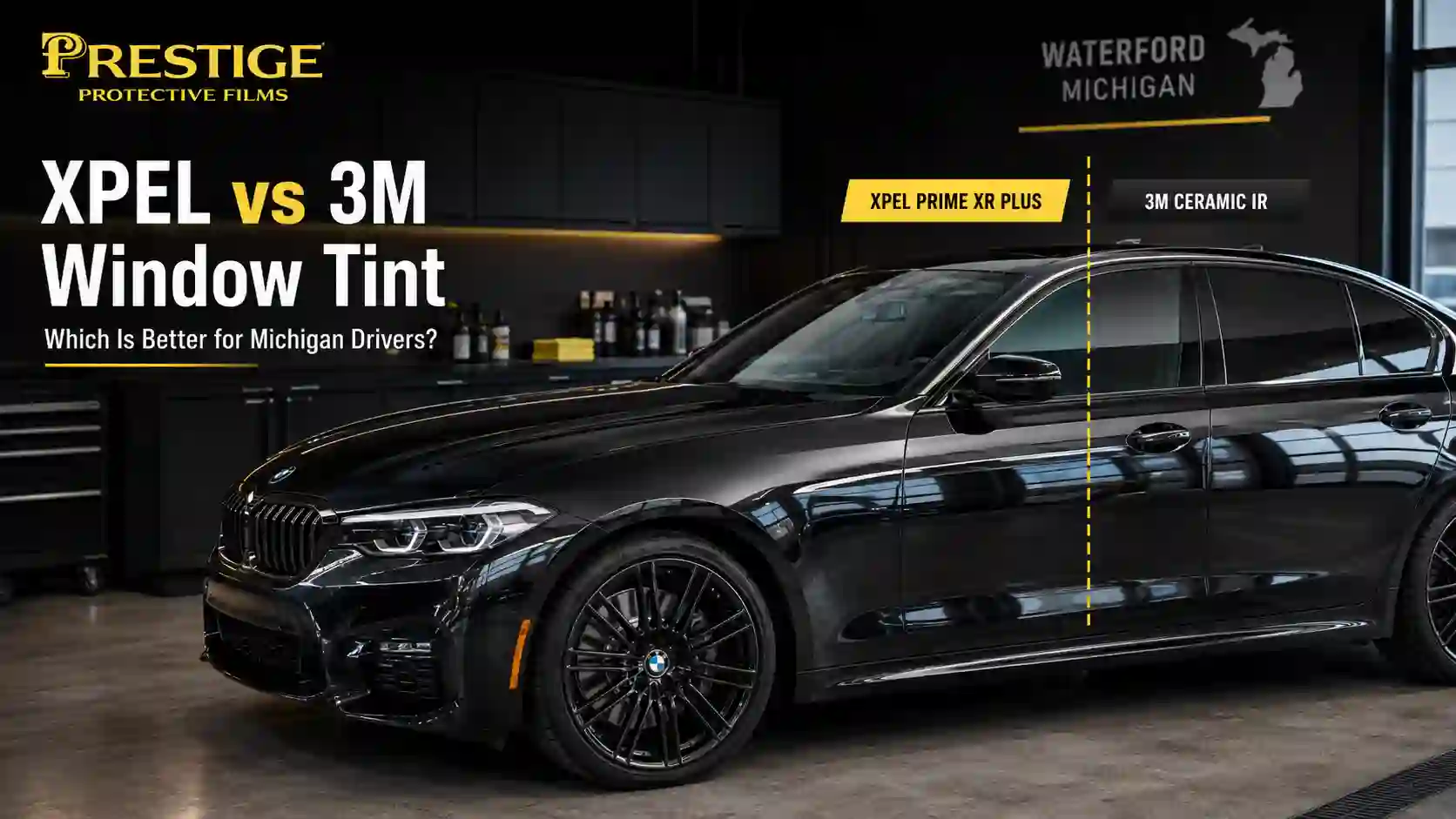
XPEL vs 3M window tint is not a comparison with one automatic winner. XPEL PRIME XR PLUS emphasizes premium solar performance across many shades. 3M Ceramic IR combines strong heat control, low reflectivity, and high UV rejection. The right choice depends on the vehicle, finished shade, coverage, budget, and installer.
Prestige Protective Films installs ceramic window tint in Waterford, MI. This guide compares published specifications, real selection factors, Michigan driving conditions, warranty questions, and installation quality.
XPEL or 3M: Which Window Tint Is Better?
XPEL PRIME XR PLUS may suit drivers prioritizing the strongest manufacturer-published solar performance. Its specification sheet lists broad shade coverage and consistently high infrared energy rejection. The darker choices publish higher TSER values.
3M Ceramic IR may suit drivers prioritizing low visible reflectivity, strong UV rejection, and a familiar film platform. Its published performance remains competitive across light and dark shades. It also uses a metal-free construction.
Neither label replaces a matched comparison. Drivers should compare the exact film, finished VLT, glass, coverage, warranty, and installed price. A skilled installation can matter more than a small difference on a data sheet.
XPEL PRIME XR PLUS vs 3M Ceramic IR at a Glance
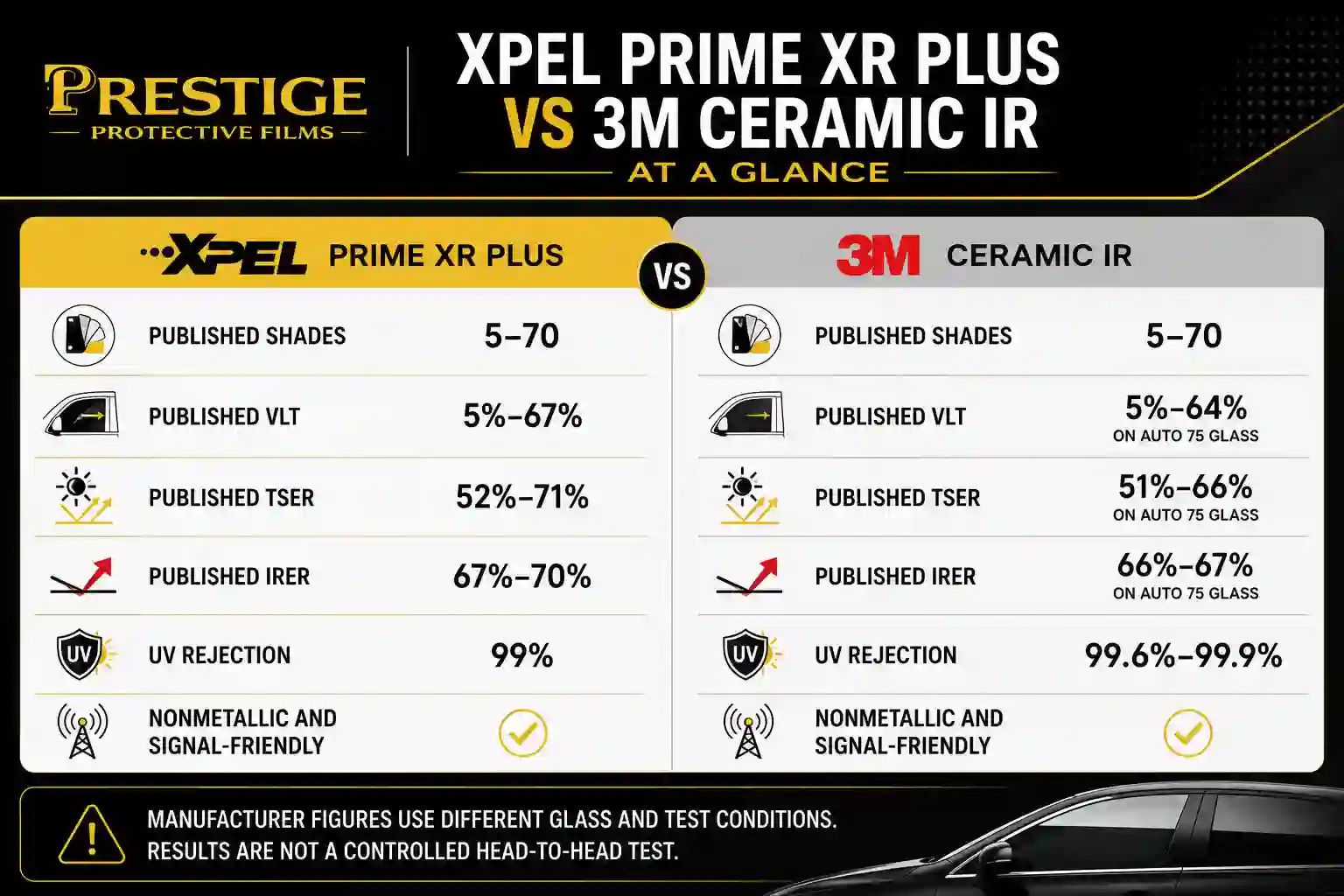
The table summarizes manufacturer-published ranges. It does not represent a controlled head-to-head test. XPEL and 3M used different glass thicknesses, base-glass values, and reporting methods.
| Comparison Point | XPEL PRIME XR PLUS | 3M Ceramic IR |
| Published shade range | 5 through 70 | 5 through 70 |
| Published VLT range | 5% to 67% | 5% to 64% on Auto 75 glass |
| Published TSER range | 52% to 71% | 51% to 66% on Auto 75 glass |
| Published IRER range | 67% to 70% | 66% to 67% on Auto 75 glass |
| Narrow-band IR rejection | 92% to 96% | 78% to 95% |
| Published UV rejection | 99% | 99.6% to 99.9% |
| Metal-free construction | Yes | Yes |
| Electronic signal interference | Not expected | Not expected |
Drivers can compare complete window tint packages in Waterford after identifying the required windows. The same film can produce different finished results on two vehicles.
Which XPEL and 3M Film Lines Are Being Compared?
XPEL PRIME includes several products. PRIME CS is an entry product, while PRIME XR Black uses ceramic construction. PRIME XR PLUS sits at the premium end. Comparing XR PLUS with a basic dyed film would not answer a fair brand question.
3M also offers several automotive films. Ceramic IR is a premium ceramic option with multiple shade levels. Other 3M products use different constructions and target different performance goals. Product names must appear on the written quote.
Prestige Protective Films offers XPEL PRIME XR PLUS and 3M Ceramic IR. That pairing creates a useful premium comparison. Drivers choosing a lower-priced tier should compare that tier separately.
Which Film Rejects More Heat?
XPEL publishes TSER values from 52% to 71% for PRIME XR PLUS. Its IRER values range from 67% to 70%. 3M publishes TSER values from 51% to 66% on Auto 75 glass. Its corresponding IRER range is 66% to 67%.
Those ranges suggest a performance advantage for XR PLUS within each brand’s published data. They do not prove the same advantage on every Michigan vehicle. Different test glass and procedures prevent a simple numerical winner.
TSER describes total rejected solar energy and deserves priority. Infrared percentages cover only part of the solar spectrum. The ceramic tint versus regular tint cost comparison explains when stronger heat control can justify a higher price.
Which Tint Works Better for Michigan Driving?
Michigan drivers experience bright summers, cold winters, changing sun angles, and long periods of overcast weather. Ceramic film remains useful during cooler months because low-angle sunlight can still create glare and direct radiant heat.
Prestige Protective Films can compare each shade on the vehicle’s existing glass. Large windshields, sloped rear glass, and panoramic roofs change solar exposure. Dark interiors can also feel warmer than light interiors.
Drivers considering premium ceramic window film for Auburn Hills vehicles should prioritize coverage before chasing a single percentage. Protecting the most exposed lawful glass may create more value than upgrading one small window.
Which Film Offers Better Clarity and Appearance?
Both products target low reflectivity and clear outward vision. Appearance still depends on shade, factory glass color, cabin color, lighting, and installation. Online photographs cannot provide a reliable comparison.
XPEL publishes visible reflectance values between 6% and 9% for XR PLUS. 3M lists exterior reflectance between 4% and 7% on Auto 75 glass. These figures suggest both products avoid a strongly mirrored appearance.
Evaluate clarity from inside the actual vehicle. Check for haze, color shift, reflections, and distortion around curved glass. Night visibility depends more on finished VLT than the brand name.
How Do XPEL and 3M Affect GPS and Electronics?
XPEL PRIME XR PLUS and 3M Ceramic IR use nonmetallic constructions. They should not interfere with cell service, GPS, Bluetooth, satellite radio, or common keyless-entry systems.
This feature matters in newer vehicles with connected navigation and wireless controls. It also benefits vehicles using toll transponders or dashboard accessories. Metallic film can create different signal concerns.
Electronics compatibility does not confirm sensor compatibility for every glass panel. Windshields may contain cameras, antennas, heating elements, or head-up display areas. The installer should inspect those systems first.
Which Brand Has Better Shade Options?
XPEL XR PLUS is available in 5, 15, 20, 30, 35, 45, 55, and 70 options. 3M Ceramic IR is published in 5, 15, 25, 30, 35, 50, and 70 options.
The number printed in a product name does not always equal the completed vehicle measurement. Factory glass already filters visible light. Film and glass combine to produce the finished VLT.
XPEL provides more intermediate choices in its published XR PLUS lineup. 3M still covers common light, medium, and dark categories. Availability can vary by installer and current inventory.
How Do Their Warranties and Durability Compare?
Both brands market premium automotive films through professional dealer networks. Warranty coverage depends on the exact product, installer status, purchaser, location, and documentation. A verbal lifetime claim is not enough.
The invoice should identify the manufacturer, film series, shade, covered windows, installation date, and vehicle. Drivers should also receive applicable warranty documents. Ask how a future claim would be inspected and processed.
Durability depends on film quality and installation conditions. Cleaning methods, glass movement, edge placement, and environmental exposure also matter. Neither brand is immune to damage from abrasive cleaners or sharp objects.
Is XPEL or 3M Window Tint More Expensive?
Neither brand is always more expensive. Installed pricing depends on the product tier, vehicle, window count, old-film removal, rear-glass shape, and local labor. Compare XR PLUS and Ceramic IR as premium products.
A quote should separate sides and rear, front windows, windshield strip, sunroof, and removal. It should also identify taxes and warranty coverage. Package names alone can hide different glass areas.
A lower quote may use a different XPEL or 3M series. Ask for the complete product name before comparing totals. A cheaper proposal isn’t equivalent if the film tier or coverage changes.
Does Installation Quality Matter More Than Brand?
Installation quality often matters more than a small published performance difference. Dust, hair, fingers, creases, edge gaps, and trapped moisture can reduce satisfaction with either premium film.
A controlled workspace supports clean preparation. Accurate patterns reduce unnecessary cutting near seals and glass. Proper shrinking helps film conform to curved rear windows without fingers or stress.
Final inspection should check edges, contamination, switches, sensors, trim, and window operation. Drivers should receive curing and cleaning instructions. Manufacturer film cannot correct careless preparation or poor handling.
How Should Michigan Drivers Choose?
Choose XPEL PRIME XR PLUS when its available shade, measured appearance, and published solar performance match the goal. It can be attractive for large-glass vehicles, long daytime commutes, and drivers seeking premium heat control.
Choose 3M Ceramic IR when its shade, lower published reflectivity, UV performance, and installed package create the better fit. It remains a strong premium option for daily drivers and vehicles with connected electronics.
Choose the installer before choosing the logo. Request samples on the vehicle, finished-glass measurements, exact specifications, written coverage, and warranty records. Those details produce a more dependable decision.
Does Michigan Law Affect the Choice?
Michigan law regulates where automotive film may be placed. It also addresses driver visibility, rearview mirrors, medical exceptions, and excessive solar reflectivity. The brand does not change those requirements.
Michigan does not apply one darkness percentage to every window. Front-window placement receives stricter treatment than glass behind the driver. Consider factory glass and aftermarket film together.
The Michigan State Police window-tint guidance summarizes current placement and reflectivity rules. A shop should meter the existing glass before recommending a finished shade.
Conclusion
XPEL PRIME XR PLUS and 3M Ceramic IR are both credible premium films. XPEL publishes stronger numbers in several solar-performance categories. 3M publishes excellent UV rejection, low reflectivity, and signal-friendly construction.
The specifications are not a direct laboratory comparison because each manufacturer uses different test conditions. Prestige Protective Films can compare samples, shades, coverage, and finished measurements on the actual vehicle.
Frequently Asked Questions
Is XPEL window tint better than 3M Ceramic IR?
XPEL PRIME XR PLUS publishes stronger figures in several solar-performance categories, but the brands use different test glass and methods. 3M Ceramic IR offers excellent UV rejection and low reflectivity. The better choice depends on the shade, vehicle glass, installer, warranty, and price.
Which blocks more heat, XPEL PRIME XR PLUS or 3M Ceramic IR?
XPEL publishes TSER values from 52% to 71% for XR PLUS. 3M lists 51% to 66% for Ceramic IR on Auto 75 glass. These ranges favor XPEL within published data, but they are not controlled head-to-head results. Compare matched shades, test conditions, and actual finished vehicle glass.
Does 3M Ceramic IR protect against ultraviolet radiation?
3M publishes UV rejection between 99.6% and 99.9% for Ceramic IR, depending on the shade and test glass. XPEL lists 99% UV rejection for XR PLUS. UV performance is only one selection factor. Drivers should also compare TSER, finished VLT, coverage, warranty, installation, and product data.
Will XPEL or 3M ceramic tint interfere with vehicle electronics?
XPEL PRIME XR PLUS and 3M Ceramic IR use nonmetallic constructions, so signal interference is not expected. Cell service, GPS, Bluetooth, satellite radio, and common keyless systems should continue working. An installer should still inspect windshield sensors, antennas, and display areas.
Which tint is better for nighttime visibility in Michigan?
Neither XPEL nor 3M automatically provides better nighttime visibility. Finished VLT, factory glass, lighting, and driver vision matter more than the brand. Lighter shades generally preserve clearer outward vision. Ceramic construction can still provide useful daily solar performance.
Can XPEL film and 3M film be installed on the same vehicle?
You can use different brands on separate windows, but color, reflectivity, VLT, and warranty terms may not match. A consistent product often creates a more uniform appearance. When mixing films, follow measured glass results and a written plan that identifies the exact series used on every window.